PEG-MGF
A longer-acting pegylated MGF studied in muscle-recovery research.
Get told when a price moves or a lab test changes.
Observed median price
$71
Every observation
| Date | Observed |
|---|---|
| $47.60 | |
| $92.33 | |
| $47.60 | |
| $47.60 | |
| $47.60 | |
| $47.60 | |
| $73.66 | |
| $80.99 | |
| $79.00 | |
| $79.00 | |
| $79.00 | |
| $63.00 | |
| $79.00 | |
| $79.00 | |
| $79.00 | |
| $79.00 | |
| $79.00 | |
| $79.00 | |
| $79.00 | |
| $79.00 | |
| $79.00 | |
| $79.00 | |
| $79.00 | |
| $79.00 | |
| $79.00 | |
| $79.00 | |
| $63.00 | |
| $63.00 | |
| $55.48 | |
| $55.48 | |
| $55.48 | |
| $55.48 | |
| $55.48 | |
| $55.48 | |
| $55.48 | |
| $63.00 | |
| $63.00 |
Median of 5 listings' 30-day changes; 11 excluded for insufficient history.
16
Active listings
1 · 99.5%
Independent lab tests
$39–$480
Observed price range
4
Known aliases
Read from the certificate, not re-measured by VialGrade. Purity is not a grade. Purity vs grade
Understand this compound
What is PEG-MGF?
Preclinical / animal onlyThe muscle-repair signal MGF wearing a chemical raincoat so it lasts days instead of minutes. That turns a brief, local repair signal into a body-wide one — which is exactly what makes its effects unknown.
Good to know: Turning a naturally local, transient signal into a systemic, long-lived one is a significant departure from its physiological role, with unknown off-target and long-term effects in humans.
How does PEG-MGF work?
The science
A PEGylated (polyethylene-glycol-modified) version of MGF; shares MGF's satellite-cell-activating mechanism, but PEGylation shields it from rapid proteolysis, extending systemic half-life to roughly 48-72 hours instead of minutes.
Mechanism of action from published research — how the molecule behaves, not a claim about any product or any human-use effect.
What is PEG-MGF researched for?
Studied, largely by extrapolation from MGF biology, for systemic muscle repair and hypertrophy signaling.
- Muscle & performanceStudied in muscle-growth, repair, and physical-performance research.
- Recovery & healingStudied in tissue-repair research — tendon, ligament, muscle, and wound-healing models.
How far has the research gone?
Preclinical / animal research; human data are essentially absent, and it is used mainly in non-clinical research settings.
Where the science stands — an approved drug is not the same as the research-grade material a vendor sells, which is unregulated regardless.
What should I check before buying?
- Independent purity. Look for a third-party COA (Janoshik or MZ) showing a measured purity — not just a number the vendor typed.
- Batch match. The strongest evidence is a certificate for the exact batch you’ll receive, attributed to this vendor — check the cross-verification on the listing.
- Vendor reputation. See how the vendor is talked about in the community before trusting a new name.
Research context only — VialGrade never gives dosing, medical, or human-use guidance.
Current market
The PEG-MGF market
Every PEG-MGF listing we track — 16 in all. The standout picks first where the evidence supports them, then the full table, ranked by what a milligram really costs wherever the vendor published a strength we can read.
Open full marketPEG-MGF – 5MG
Core PeptidesB+
$63$12.6/mg-35% vs median
Lowest price per mg that isn't flagged as suspiciously cheap.
In stockChecked 9 hours ago
PEG-MGF PEPTIDE 2MG/5MG VIAL 5MG
Umbrella LabsC-
$40$8.00/mg-59% vs median
Lowest real cost per active mg — price divided by measured purity.
In stockChecked 4 days ago
PEG-MGF 2 mg
Sports Technology LabsA
$50$25.0/mg+28% vs median
Independently tested at 99.5%.
In stockChecked 9 hours ago
PEG MGF 2mg KIT (10 vials)
Swiss ChemsC-
$480$24.0/mg+23% vs median
The most recently re-verified listing on this market.
In stockChecked 9 hours ago
PEG-MGF PEPTIDE 2MG/5MG VIAL 5 Milligrams Vial
Umbrella LabsC-
$76$15.2/mg-22% vs median
Ranked #3 of 13 listings by price per milligram.
In stockChecked 4 days ago
Compare by real cost
Every PEG-MGF listing, cheapest per mg first
Sticker prices hide the size, so listings are ranked by what a milligram actually costs — with independently tested purity where it exists. All 16 are here: the last 3 are listings whose vendor never published a strength we can read, so they have no per-mg figure to sort on.
| # | Vendor | Size | Price | Per mg | Tested purity | Real $/active mg | |
|---|---|---|---|---|---|---|---|
| 1 | Umbrella Labs | 5mg total | $40 | $8.00/mg · too cheap? | — | $8.04/mgbest value | View |
| 2 | Core Peptides | 5mg total | $63 | $12.6/mg | — | $12.7/mg | View |
| 3 | Umbrella Labs | 5mg total5 Milligrams Vial each | $76 | $15.2/mg | — | $15.3/mg | View |
| 4 | Biotech Peptides | 5mg total | $79 | $15.8/mg | — | $15.9/mg | View |
| 5 | Purerawz | 10mg total | $179 | $17.9/mg | — | $18.0/mg | View |
| 6 | Modern AminosUnavailable | 2mg total | $39 | $19.5/mg | — | $19.6/mg | View |
| 7 | Ion PeptideUnavailable | 2mg total | $39 | $19.5/mg | — | $19.6/mg | View |
| 8 | Simple Peptide | 2mg total | $39 | $19.5/mg | — | $19.6/mg | View |
| 9 | Purerawz | 5mg total | $100 | $20.1/mg | — | $20.2/mg | View |
| 10 | Peptide Pros | 2mg total | $47 | $23.6/mg | — | $23.8/mg | View |
| 11 | Swiss Chems | 2mg total | $48 | $24.0/mg | — | $24.1/mg | View |
| 12 | Swiss Chems | 20mg totalKIT (10 vials) each | $480 | $24.0/mg | — | $24.1/mg | View |
| 13 | Sports Technology Labs | 2mg total | $50 | $25.0/mg | 99.5% | $25.1/mg | View |
| Listed, but not rankable — no published strength to price per mg | |||||||
| — | Purerawz | 1 vial | $66 | no size published | — | — | View |
| — | Purerawz | Nasal Spray · 20mcg per spray/2mg | $84 | no size published | — | — | View |
| — | Behemoth Labz | 1 vial | $194 | no size published | — | — | View |
Real $/active mg divides the price-per-mg by the measured purity — the honest cost of the actual peptide, so a 90%-pure vial isn’t compared as if it were 99%. Too cheap? flags a listing far below the market rate — often underdosing or a fake, not a deal. The crown marks the cheapest non-outlier; best value marks the lowest real cost per active mg. A vendor shown as Unavailable or Low stock is priced here but not currently buyable.
Independent testing
PEG-MGF — independent lab tests
Real, publicly verifiable third-party tests. Purity is read from the certificate itself. A test reflects one lab’s result for one submitted batch — not a guarantee that every vial matches.
How does this data get here?
Every record below is a real certificate of analysis, gathered two ways: from the public verification feeds that independent labs (like Janoshik) publish, and from the certificates vendors post on their own product pages. We open each certificate document and read the measured purity, content, batch, and date directly off it — a scraper can’t read a number printed inside an image, so this is done by machine vision, then recorded here with a link back to the original.
Nothing here is typed in by a vendor or invented by us. Where a certificate is missing, we say so rather than filling the gap.
We re-check the lab feed, too. A “still listed” tag means the certificate is currently public in Janoshik’s database — we re-verify against the live feed and stamp the date. If a cert is later pulled, the tag flips. It’s a freshness check on the same source, not a second independent opinion.
What a certificate does & doesn’t prove
Three different questions. Purity (“how clean?”), identity (“is it the right molecule?”, a mass-spec test), and content (“did I get the labeled mg?”) are separate. A vial can be 99% pure and still be the wrong peptide, or the right peptide underdosed. We flag the measured dose against the label above; underdosing is the most common real fraud.
Who submitted the sample matters. Most of these are vendor-submitted — the seller chose which vial to send, so one good certificate doesn’t prove every batch is the same. The gold standard is a blind test, where a buyer sends a vial they bought as a normal customer. Same label doesn’t prove same product; same batch number doesn’t prove same batch.
99.5%
highest tested purity
| Certificate | Manufacturer | Batch | Purity | Content / dose | Lab | |
|---|---|---|---|---|---|---|
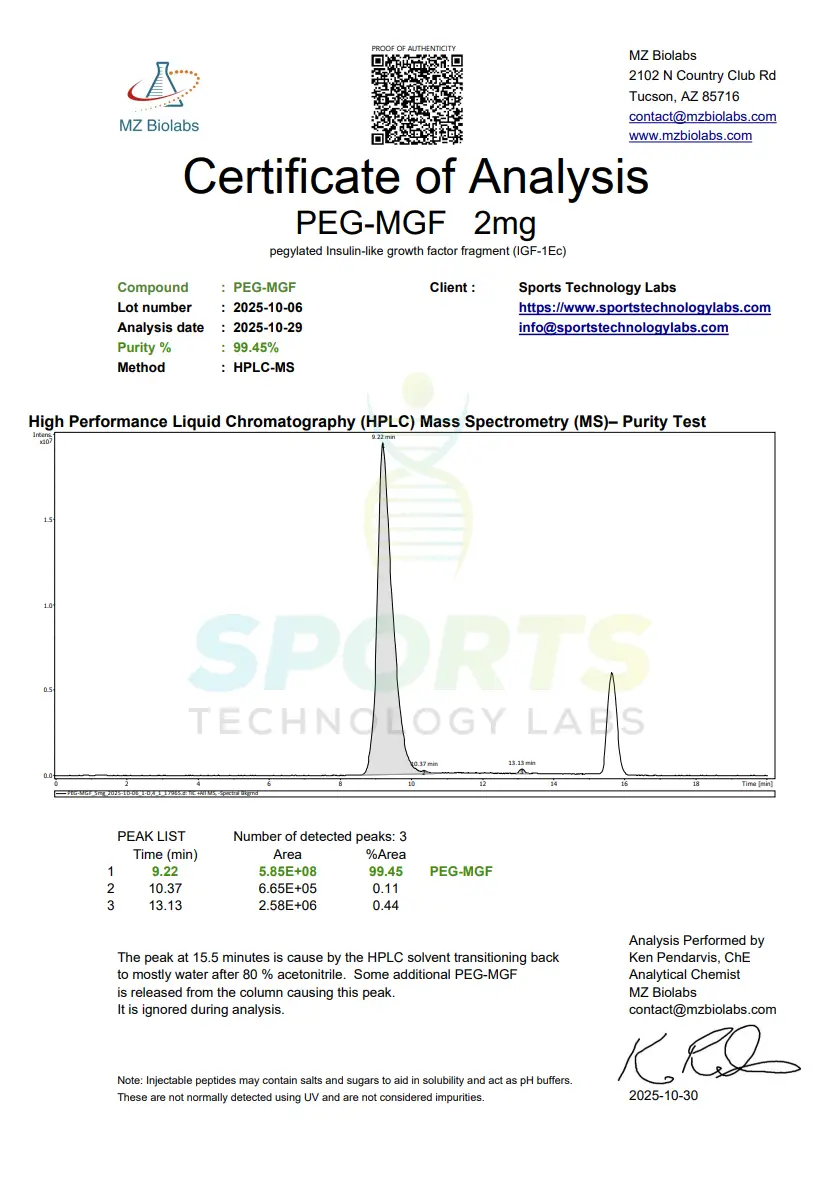 | Sports Technology Labs | 2025-10-06 | 99.45% | — | MZ Biolabs | View |
Tested batches
Batch test records for PEG-MGF
The full test history for one batch — who picked the sample, who tested it, and what came back. It describes the vials that were tested, never every vial they sold.
What the research says
Scientific evidence & regulatory status
What the published literature actually shows about PEG-MGF — separate from any vendor’s marketing. Each finding links to its paper. This is education, not medical or dosing advice.
Regulatory status
No FDA-approved drug
Not FDA-approved. FDA placed pegylated mechano growth factor in category 2 (significant safety risks) for compounding, stating it had identified no human exposure data for any route; the nomination was later withdrawn. WADA prohibits mechano growth factors at all times (S2.3).
Research-use-only — not FDA-approved
Sold “for research use only,” this compound is not FDA-approved for human use and has not been evaluated for safety, purity, or sterility in people. It is generally not a scheduled controlled substance, so buying it as a research chemical is typically not itself a drug crime — but marketing or using it as a drug is not lawful, and it is not a dietary supplement.
General information, not legal or medical advice. VialGrade sells nothing and encourages no human use.
Research notes aren’t product proof
Research summaries describe published literature and market data only. They do not establish the identity, quality, safety, or legal status of any listed physical product.