BPC-157
One of the most-discussed peptides in tissue-recovery and gut-health research. Preclinical studies have looked at connective-tissue and gastrointestinal models. The classic partner to TB-500.
Get told when a price moves or a lab test changes.
Observed median price
$68
Every observation
| Date | Observed |
|---|---|
| $56.00 | |
| $107.59 | |
| $68.00 | |
| $49.99 | |
| $59.97 | |
| $63.50 | |
| $67.00 | |
| $67.00 | |
| $67.50 | |
| $69.00 | |
| $68.50 | |
| $68.50 | |
| $68.00 | |
| $69.00 | |
| $68.00 | |
| $68.00 | |
| $68.00 | |
| $68.00 | |
| $69.68 | |
| $68.50 | |
| $68.00 | |
| $68.50 | |
| $68.50 | |
| $68.00 | |
| $67.50 | |
| $68.00 | |
| $68.00 | |
| $68.00 | |
| $59.99 | |
| $59.99 | |
| $59.97 | |
| $59.99 | |
| $59.99 | |
| $59.99 | |
| $59.99 | |
| $59.97 | |
| $59.95 | |
| $54.99 | |
| $57.47 |
Median of 25 listings' 30-day changes; 38 excluded for insufficient history.
62
Active listings
11 · 99.7%
Independent lab tests
$18–$1,654
Observed price range
6
Known aliases
Read from the certificate, not re-measured by VialGrade. Purity is not a grade. Purity vs grade
Understand this compound
What is BPC-157?
Preclinical / animal onlya.k.a. Body Protection Compound-157, PL 14736A lab-made copy of a tiny piece of a protein your stomach makes to protect itself. Researchers study whether that same protect-and-repair signal helps injured tendons, muscle, and gut lining heal — gym circles nickname it the 'Wolverine peptide', but the evidence is almost entirely from animal studies.
Good to know: Human safety and pharmacokinetic data remain extremely limited despite widespread anecdotal use, and the FDA has moved to restrict it from compounding pharmacies over unresolved safety-data gaps.
How does BPC-157 work?
The science
A synthetic 15-amino-acid partial sequence derived from a protective protein found in human gastric juice; in animal models it appears to promote angiogenesis via VEGF upregulation, modulate nitric oxide signaling, and upregulate growth-hormone receptor expression on fibroblasts to accelerate tissue repair.
Mechanism of action from published research — how the molecule behaves, not a claim about any product or any human-use effect.
What is BPC-157 researched for?
Studied mainly for tendon, ligament, muscle, and gastrointestinal-lining healing in animal injury models.
- Recovery & healingStudied in tissue-repair research — tendon, ligament, muscle, and wound-healing models.
- Gut healthStudied in gastrointestinal research, including gut-lining integrity and inflammatory-condition models.
How far has the research gone?
Preclinical / animal research — hundreds of rodent studies exist, but only a handful of small, uncontrolled human studies have been published, and it is not FDA-approved.
Where the science stands — an approved drug is not the same as the research-grade material a vendor sells, which is unregulated regardless.
What should I check before buying?
- Independent purity. Look for a third-party COA (Janoshik or MZ) showing a measured purity — not just a number the vendor typed.
- Batch match. The strongest evidence is a certificate for the exact batch you’ll receive, attributed to this vendor — check the cross-verification on the listing.
- Vendor reputation. See how the vendor is talked about in the community before trusting a new name.
Research context only — VialGrade never gives dosing, medical, or human-use guidance.
Current market
The BPC-157 market
Every BPC-157 listing we track — 62 in all. The standout picks first where the evidence supports them, then the full table, ranked by what a milligram really costs wherever the vendor published a strength we can read.
Open full marketBPC-157 20MG
Simple PeptideC+
$85$4.25/mg-36% vs median
Lowest price per mg that isn't flagged as suspiciously cheap.
In stockChecked 2 days ago
BPC-157 Arginine + Osthole 98% + 5a-hydroxy Laxogenin + PEA with Levagen Capsules 237.75mg per capsule/60ct/14.265g
PureRawzC-
$211$0.01/mg-100% vs median
Lowest real cost per active mg — price divided by measured purity.
In stockChecked 9 days ago
BPC 157 – 50 VIALS AT 30 PERCENT OFF 5mg/vial × 50 vials
Peptide ProsC+
$1,654$6.62/mg
Independently tested at 100.0%.
In stockChecked 9 hours ago
BPC-157 – 5MG / 10MG
Core PeptidesB+
$97$9.70/mg+47% vs median
2 independent lab tests on file for this vendor.
In stockChecked 9 hours ago
BPC-157 PEPTIDE POWDER (60 CAPSULES) (500MCG/CAPSULE, 30MG TOTAL BOTTLE)
Umbrella LabsC-
$150$5.00/mg-24% vs median
The most recently re-verified listing on this market.
UnavailableChecked 8 hours ago
Compare by real cost
Every BPC-157 listing, cheapest per mg first
Sticker prices hide the size, so listings are ranked by what a milligram actually costs — with independently tested purity where it exists. All 62 are here: the last 20 are listings whose vendor never published a strength we can read, so they have no per-mg figure to sort on.
| # | Vendor | Size | Price | Per mg | Tested purity | Real $/active mg | |
|---|---|---|---|---|---|---|---|
| 1 | Purerawz | 14.27g total237.75mg per capsule/60ct/14.265g each | $211 | $0.01/mg · too cheap? | — | $0.01/mgbest value | View |
| 2 | Swiss Chems | 30mg total0.5mg each | $86 | $2.87/mg · too cheap? | — | $2.87/mg | View |
| 3 | Simple Peptide | 20mg total | $85 | $4.25/mg | — | $4.26/mg | View |
| 4 | Ez Peptides | 10mg total | $44 | $4.40/mg | — | $4.41/mg | View |
| 5 | Ez Peptides | 50mg total500mcg each | $225 | $4.50/mg | — | $4.51/mg | View |
| 6 | Chameleon PeptidesUnavailable | 100mg total10mg · 10-vial kit each | $451 | $4.51/mg | 99.8% | $4.52/mg | View |
| 7 | Chameleon Peptides | 15mg total | $69 | $4.60/mg | 99.8% | $4.61/mg | View |
| 8 | Ascension Peptides | 10mg total | $49 | $4.90/mg | — | $4.91/mg | View |
| 9 | Umbrella LabsUnavailable | 30mg total500MCG each | $150 | $5.00/mg | — | $5.01/mg | View |
| 10 | Simple Peptide | 15mg total | $75 | $5.00/mg | — | $5.01/mg | View |
| 11 | Chameleon Peptides | 50mg total10mg · 5-vial pack each | $251 | $5.01/mg | 99.8% | $5.02/mg | View |
| 12 | Ascend Bio LabsUnavailable | 30mg total3 Vials / 10MG each | $153 | $5.10/mg | 99.1% | $5.15/mg | View |
| 13 | Bluum Peptides | 20mg total | $105 | $5.25/mg | — | $5.27/mg | View |
| 14 | Chameleon Peptides | 10mg total | $53 | $5.31/mg | 99.8% | $5.32/mg | View |
| 15 | Ascend Bio LabsUnavailable | 20mg total2 Vials / 10MG each | $108 | $5.40/mg | 99.1% | $5.45/mg | View |
| 16 | Felix Chemical Supply | 10mg total | $55 | $5.50/mg | — | $5.52/mg | View |
| 17 | Chameleon PeptidesUnavailable | 50mg total5mg · 10-vial kit each | $291 | $5.81/mg | 99.8% | $5.83/mg | View |
| 18 | Swiss ChemsUnavailable | 10mg total | $60 | $6.00/mg | — | $6.01/mg | View |
| 19 | Cernum Biosciences | 10mg total | $60 | $6.00/mg | — | $6.02/mg | View |
| 20 | Chameleon Peptides | 25mg total5mg · 5-vial pack each | $162 | $6.46/mg | 99.8% | $6.47/mg | View |
| 21 | Peptide Pros | 250mg total5mg/vial × 50 vials each | $1,654 | $6.62/mg | 100.0% | $6.62/mg | View |
| 22 | Bluum Peptides | 10mg total | $68 | $6.80/mg | — | $6.82/mg | View |
| 23 | Modern Aminos | 10mg total | $68 | $6.80/mg | — | $6.82/mg | View |
| 24 | Ascend Bio LabsUnavailable | 10mg total | $70 | $7.00/mg | 99.1% | $7.06/mg | View |
| 25 | Ascend Bio LabsUnavailable | 10mg total | $73 | $7.30/mg | 99.1% | $7.37/mg | View |
| 26 | Modern Aminos | 5mg total | $38 | $7.60/mg | — | $7.62/mg | View |
| 27 | Bluum Peptides | 5mg total | $39 | $7.80/mg | — | $7.82/mg | View |
| 28 | Purerawz | 15mg total | $126 | $8.40/mg | — | $8.42/mg | View |
| 29 | Umbrella Labs | 10mg total10 Milligrams Vial each | $88 | $8.82/mg | — | $8.84/mg | View |
| 30 | Biotech Peptides | 10mg total | $92 | $9.20/mg | — | $9.23/mg | View |
| 31 | Peptide Pros | 5mg total | $47 | $9.45/mg | 100.0% | $9.45/mg | View |
| 32 | Core Peptides | 10mg total | $97 | $9.70/mg | 99.8% | $9.72/mg | View |
| 33 | Core Peptides | 5mg total | $52 | $10.4/mg | 99.8% | $10.4/mg | View |
| 34 | Biotech Peptides | 5mg total | $52 | $10.4/mg | — | $10.4/mg | View |
| 35 | Ez Peptides | 5mg total | $53 | $10.6/mg | — | $10.6/mg | View |
| 36 | Sports Technology Labs | 5mg total | $55 | $11.0/mg | 99.4% | $11.1/mg | View |
| 37 | PurerawzUnavailable | 10mg total | $141 | $14.1/mg | — | $14.1/mg | View |
| 38 | Behemoth LabzUnavailable | 10mg total | $175 | $17.5/mg | — | $17.5/mg | View |
| 39 | Purerawz | 5mg total | $89 | $17.8/mg | — | $17.9/mg | View |
| 40 | PurerawzUnavailable | 10mg total | $178 | $17.8/mg | — | $17.9/mg | View |
| 41 | Behemoth LabzUnavailable | 6mg total | $164 | $27.3/mg | — | $27.4/mg | View |
| 42 | PurerawzUnavailable | 6mg total | $164 | $27.4/mg | — | $27.5/mg | View |
| Listed, but not rankable — no published strength to price per mg | |||||||
| — | Eternal Peptides | 1 vial | $18 | no size published | — | — | View |
| — | Chameleon Peptides | 1 vial | $34 | no size published | 99.8% | — | View |
| — | Nootropic Source | 1 vial | $35 | no size published | — | — | View |
| — | Swiss Chems | 1 vial | $40 | no size published | — | — | View |
| — | Nootropic Source | 1 vial | $50 | no size published | — | — | View |
| — | Cernum Biosciences | 1 vial | $50 | no size published | — | — | View |
| — | Umbrella Labs | 15ML | $50 | no size published | — | — | View |
| — | Umbrella LabsUnavailable | 5mg Liquid Spray Solution 15mL Bottle | $50 | no size published | — | — | View |
| — | Simple Peptide | 1 vial | $55 | no size published | — | — | View |
| — | Modern Aminos | 1 vial | $67 | no size published | — | — | View |
| — | Ascend Bio LabsUnavailable | 1 Bottle | $70 | no size published | 99.1% | — | View |
| — | Purerawz | 1 vial | $70 | no size published | — | — | View |
| — | Behemoth LabzUnavailable | 1 vial | $87 | no size published | — | — | View |
| — | Umbrella Labs | 10mg Liquid Spray Solution 15mL Bottle | $95 | no size published | — | — | View |
| — | Purerawz | 325.5mg/30ct/9.75g | $98 | no size published | — | — | View |
| — | Umbrella Labs | 30ML | $120 | no size published | — | — | View |
| — | Ascend Bio LabsUnavailable | 2 Bottles | $128 | no size published | 99.1% | — | View |
| — | PurerawzUnavailable | Sublingual Tablets · 400mcg/60ct/24mg | $155 | no size published | — | — | View |
| — | Simple Peptide | 500MCG | $170 | no size published | — | — | View |
| — | PurerawzUnavailable | 325.5mg/ 60ct/19.53g | $180 | no size published | — | — | View |
Real $/active mg divides the price-per-mg by the measured purity — the honest cost of the actual peptide, so a 90%-pure vial isn’t compared as if it were 99%. Too cheap? flags a listing far below the market rate — often underdosing or a fake, not a deal. The crown marks the cheapest non-outlier; best value marks the lowest real cost per active mg. A vendor shown as Unavailable or Low stock is priced here but not currently buyable.
Independent testing
BPC-157 — independent lab tests
Real, publicly verifiable third-party tests. Purity is read from the certificate itself. A test reflects one lab’s result for one submitted batch — not a guarantee that every vial matches.
How does this data get here?
Every record below is a real certificate of analysis, gathered two ways: from the public verification feeds that independent labs (like Janoshik) publish, and from the certificates vendors post on their own product pages. We open each certificate document and read the measured purity, content, batch, and date directly off it — a scraper can’t read a number printed inside an image, so this is done by machine vision, then recorded here with a link back to the original.
Nothing here is typed in by a vendor or invented by us. Where a certificate is missing, we say so rather than filling the gap.
We re-check the lab feed, too. A “still listed” tag means the certificate is currently public in Janoshik’s database — we re-verify against the live feed and stamp the date. If a cert is later pulled, the tag flips. It’s a freshness check on the same source, not a second independent opinion.
What a certificate does & doesn’t prove
Three different questions. Purity (“how clean?”), identity (“is it the right molecule?”, a mass-spec test), and content (“did I get the labeled mg?”) are separate. A vial can be 99% pure and still be the wrong peptide, or the right peptide underdosed. We flag the measured dose against the label above; underdosing is the most common real fraud.
Who submitted the sample matters. Most of these are vendor-submitted — the seller chose which vial to send, so one good certificate doesn’t prove every batch is the same. The gold standard is a blind test, where a buyer sends a vial they bought as a normal customer. Same label doesn’t prove same product; same batch number doesn’t prove same batch.
100.0%
highest tested purity
| Certificate | Manufacturer | Batch | Purity | Content / dose | Lab | |
|---|---|---|---|---|---|---|
| Peptide Pros | AF98762213 | 100.00% | — | MZ Biolabs | Verify | |
| hangzhoupeps.com | — | 99.89% | 5.56/5mg · full | Janoshik Analytical Still listed | Verify | |
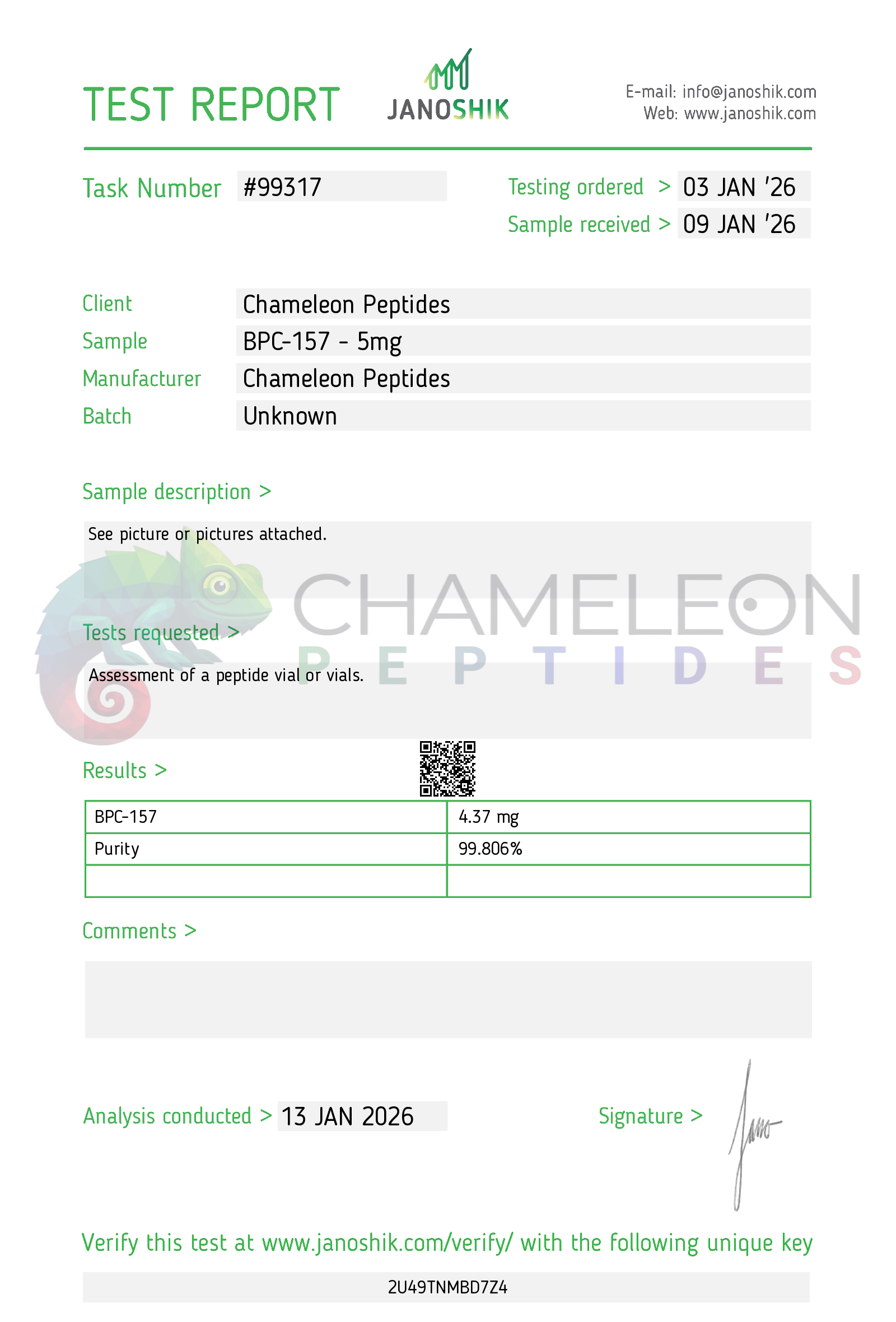 | Chameleon Peptides | — | 99.81% | 4.37 mg | Janoshik Analytical | View |
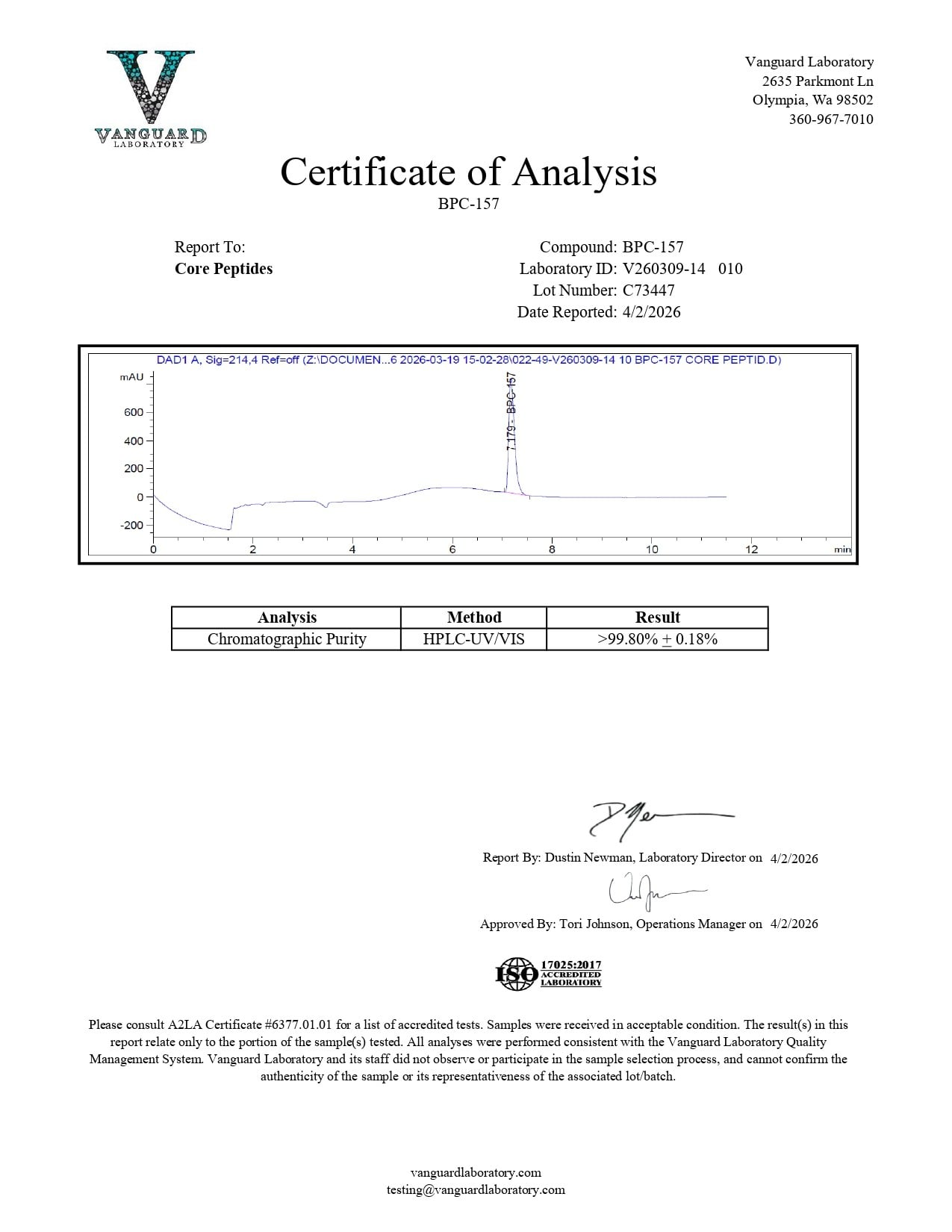 | Core Peptides | C73447 | 99.80% | — | Vanguard Laboratory | View |
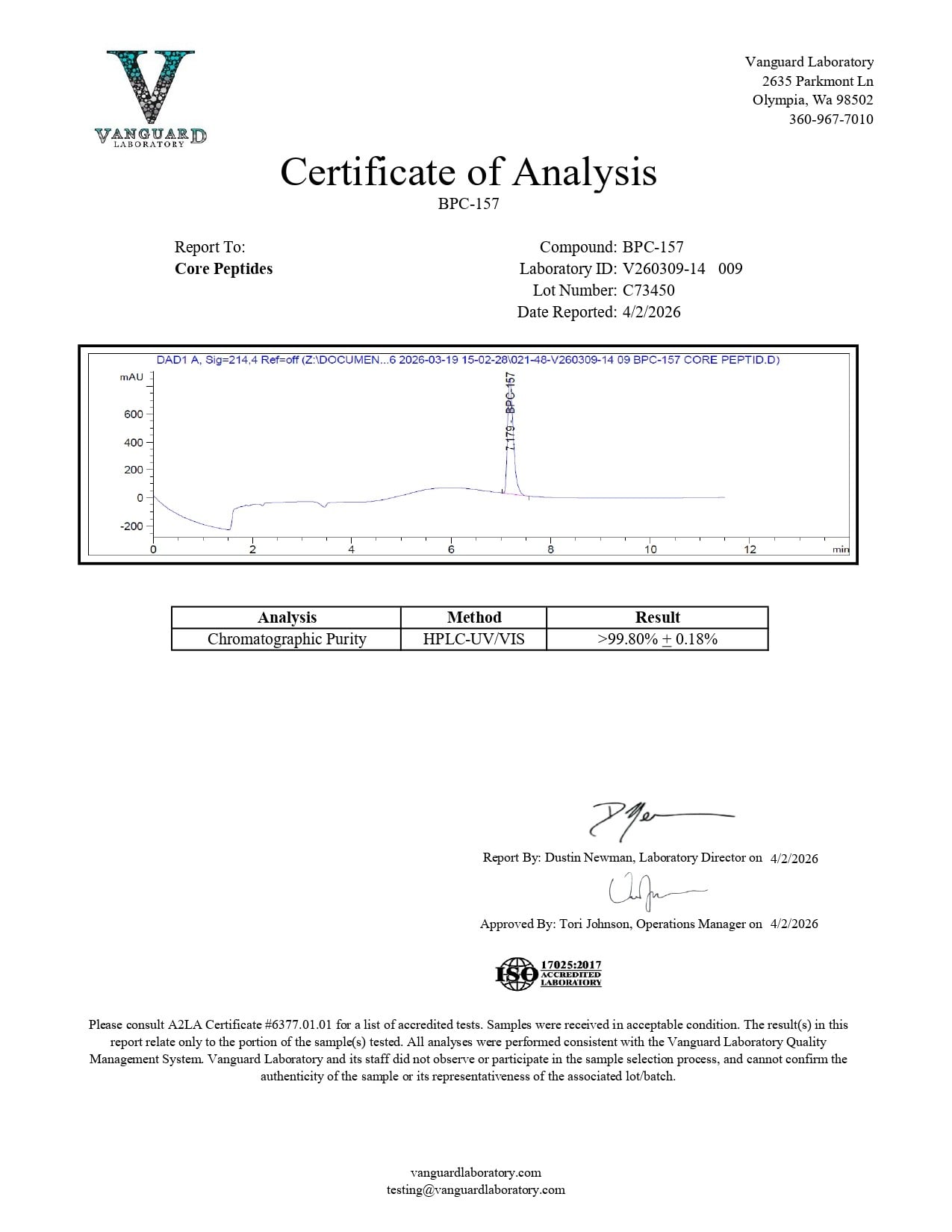 | Core Peptides | C73450 | 99.80% | — | Vanguard Laboratory | View |
| PeptideGurus | — | 99.60% | 18.4/20mg · full | Janoshik Analytical Still listed | Verify | |
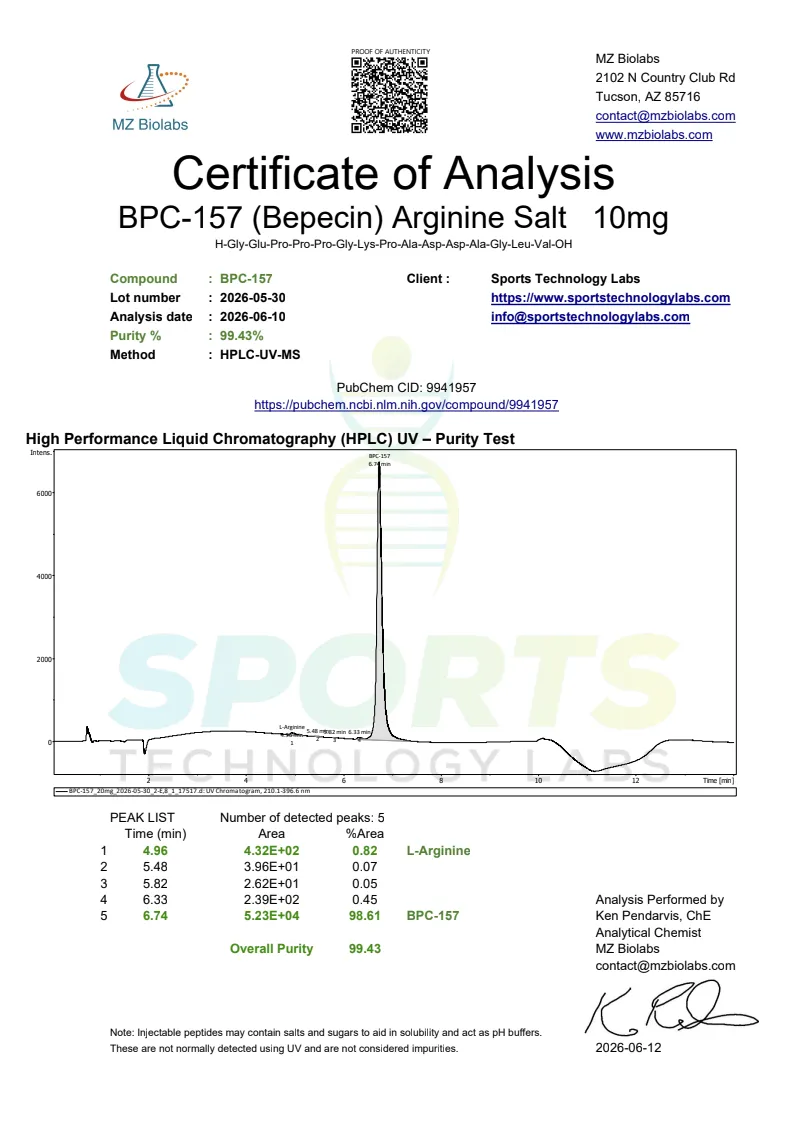 | Sports Technology Labs | 2026-05-30 | 99.43% | — | MZ Biolabs | View |
| Ascend Bio Labs | V260602-23-008 | 99.10% | — | Vanguard Laboratory | Verify | |
| Unknown | — | 99.04% | 5.62/5mg · full | Janoshik Analytical Still listed | Verify | |
| Alpha BioPharma | BWFM6CH4 | 97.70% | 11.79 mg | Janoshik Analytical Still listed | Verify | |
| longevityprolabs.com | — | See report | — | Janoshik Analytical | Verify | |
| Eternal Peptides | EP-260521-BPC05 | 99.35% | — | Unverified lab · Kovera Labs | Verify | |
| Eternal Peptides | EP-260521-BPC10 | 99.33% | — | Unverified lab · Kovera Labs | Verify | |
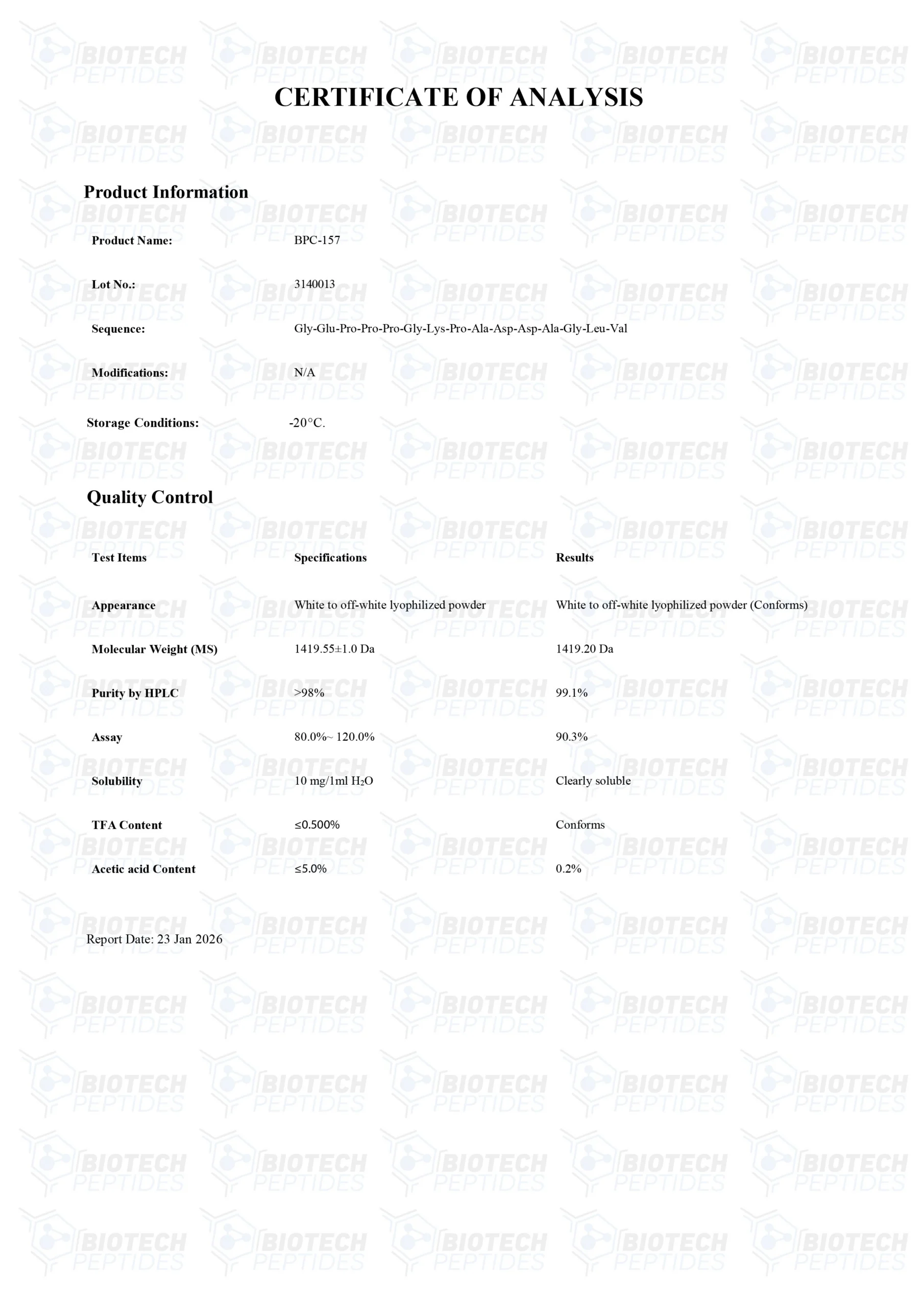 | Biotech Peptides | 3140013 | 99.10% | — | Vendor self-tested | View |
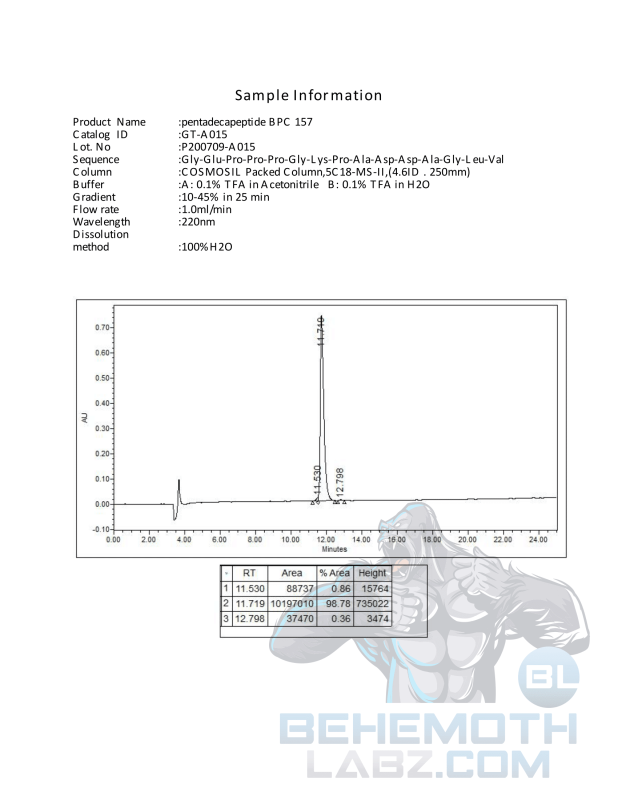 | Behemoth Labz | P200709-A015 | 98.78% | — | Vendor self-tested | View |
Tested batches
Batch test records for BPC-157
The full test history for one batch — who picked the sample, who tested it, and what came back. It describes the vials that were tested, never every vial they sold.
What the research says
Scientific evidence & regulatory status
What the published literature actually shows about BPC-157 — separate from any vendor’s marketing. Each finding links to its paper. This is education, not medical or dosing advice.
Regulatory status
No FDA-approved drug
Not FDA-approved; sold for research use only; prohibited in sport by WADA
Honest overall read
Evidence is almost entirely from animal studies; the single human report is a small uncontrolled case series, so efficacy and safety in people remain unproven.
A 2025 systematic review screening 544 papers found only 36 qualifying studies of which 35 were preclinical and just one was human (a retrospective 12-patient case series where 7 of 12 reported knee-pain relief over 6 months), and it found no clinical safety data.
No randomized controlled human trials exist and no human safety data have been published; injectable products are unregulated.
read the sourceIn rodent models, the stable gastric pentadecapeptide BPC 157 has been reported to accelerate healing of skin, muscle, tendon, ligament and gut tissue and to influence angiogenic and growth-factor pathways.
Findings are from animal experiments only and have not been reproduced in controlled human studies.
read the sourceCommonly researched together
Often stacked with BPC-157
Compounds the research community frequently discusses alongside BPC-157. Not a protocol or a recommendation — a starting point for what to read about next.
TB-500
Synthetic peptide
A fragment of thymosin beta-4 studied in recovery, flexibility, and tissue-repair research. Almost always discussed alongside BPC-157.
GHK-Cu
Copper peptide
A copper peptide famous in skincare and hair research for collagen and cosmetic contexts, also discussed for tissue recovery. The 'GLOW' in the popular recovery blend.
KPV
Synthetic peptide
A short anti-inflammatory tripeptide studied in gut and inflammatory-condition research, often paired with BPC-157 for gut-focused stacks.
Research-use-only — not FDA-approved
Sold “for research use only,” this compound is not FDA-approved for human use and has not been evaluated for safety, purity, or sterility in people. It is generally not a scheduled controlled substance, so buying it as a research chemical is typically not itself a drug crime — but marketing or using it as a drug is not lawful, and it is not a dietary supplement. BPC-157 is not on the FDA's 503A list of substances pharmacies may compound with, so even a licensed compounding pharmacy can't legally make it. The FDA flagged it in 2023 over safety concerns (immunogenicity risk by some routes); that nomination was later withdrawn, and an FDA advisory committee reviewed it again in July 2026.
General information, not legal or medical advice. VialGrade sells nothing and encourages no human use.
Research notes aren’t product proof
Research summaries describe published literature and market data only. They do not establish the identity, quality, safety, or legal status of any listed physical product.